Step-By-Step Refrigerant Recovery Process
 Dan Reggi

How do we recover refrigerant? And how do we recover faster?
I often see new techs asking how to recover or experienced techs asking how to recover faster, so let’s look at both.
This all originated from some personal trial and error when an air conditioning manufacturer I worked for had a recall – a missing Schrader core at the receiver service valve, of all things.
This was a possible disaster for an unsuspecting tech. Remove the cap expecting a valve core, and well… Not fun.
So it was time to install a single valve core in 50 operational units in critical spaces, each holding between 50 and 100 pounds of R-410A. I had a reasonably repeatable situation on my hands, and I had the opportunity to try all sorts of things, such as the size of the recovery cylinder, the size of the hose, and the type of hose.
I’ll cover all this at the bottom of this article, but we’ve got to start with the basics!
How Do We Recover?
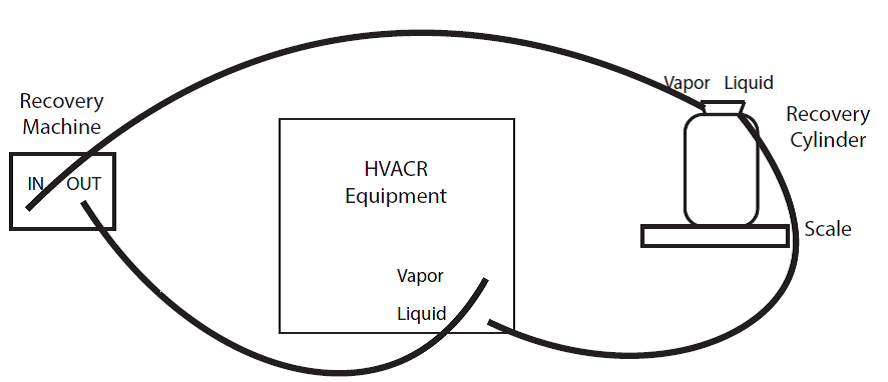
There are two typical methods: direct recovery and push/pull.
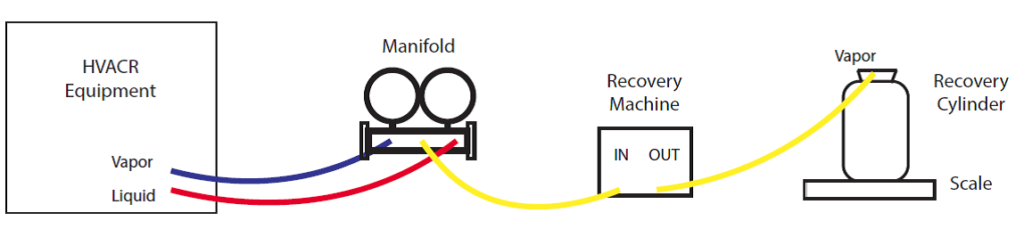
You should always familiarize yourself with the equipment you are working with, but I’ve included a simple diagram of how to connect the required equipment and a “step-by-step” guide too!
Direct Recovery
This is our typical recovery method, which will be how every recovery task will finish.
Push/Pull Recovery
This will be your faster option if the system has 15 or more pounds of refrigerant. The more refrigerant the system holds, the more time you’ll save.
PRO TIP: Using an inline sight glass during push-pull recovery will allow you to visually determine when the liquid flow has stopped.
Now Let’s Speed It Up…
Valve Core Removal Tools
If you were only going to change one thing – this is it! If you’re stuck pulling through valve cores, get two of these. They’ll even help speed up your evacuation.
Recovery Cylinder
- Make sure the cylinder is clean and has been evacuated to 500 microns or less. And NEVER fill beyond 80%. This allows for the expansion of the refrigerant.
- If it’s practical, use a larger cylinder; this will make the recovery go quicker.
Hoses
- Avoid hoses with “anti-blowback” or “low loss” style fittings.
- Standard hoses are ¼” – using larger diameter hoses will get you faster recovery. They’re often marketed as “heavy duty,” “charging,” or “vacuum” hoses.
- Use hoses that are as short as possible.
Temperature Management
- Cool down the recovery cylinder – this will drop the pressure of the recovery cylinder.
- With many recovery machines, you can use the fan to draw air over the recovery tank.
- Water will work even better, but you’ll need water flow.
- Cool down the refrigerant! This one tends to be your best bet if you’re dealing with large volumes of refrigerant – there are heat exchangers available just for this purpose.
Filter It!
If you suspect the system refrigerant to be dirty, use an inline filter drier at the inlet to the recovery machine.
With methods ranging from nothing new required to a whole new rig for recovery, you’ve got choices to speed up your recovery in just about all applications. Give some of these a try and see how they work for you.
Categories: : Service Tips